PRACTICAL SIZING GUIDE
How to Measure Nails for Press-Ons: A Practical Millimeter Guide
An accurate fit is one of the most important factors for comfortable, natural-looking press-on nails. When a set matches your natural nail bed, it sits flush against the cuticle, feels balanced during daily tasks, and avoids unnecessary tension. Here is how to measure your natural nail width in millimeters using simple household items.
Why Sizing Labels (XS–L) Differ Across Brands
When shopping for press-on nails online, relying solely on letter labels such as Extra Small, Small, Medium, or Large can lead to sizing surprises. Unlike standardized shoe or garment sizing, press-on nail dimensions vary considerably between commercial manufacturers and independent boutique artists. A "Size 1" from one studio might measure 15 millimeters wide, whereas another brand's "Size 1" measures 16 millimeters.
The Consequences of an Incorrect Fit
A press-on nail that is too narrow may create pressure along the sides and can contribute to lifting or discomfort. Conversely, wearing a nail that is too wide overlaps the lateral nail folds, which can irritate surrounding skin and increase the chance of catching on hair or clothing.
Why Millimeter Width Provides the Most Reliable Baseline
Recording your exact horizontal nail width in millimeters (mm) gives you an objective measurement. Rather than guessing whether you are a "Small" or a "Medium," you can compare your actual millimeter numbers directly against any seller's specifications. Before placing an order, consult our comprehensive press-on nails buying checklist for questions to verify regarding contents, sizing policies, and returns.
The Tape & Ruler Method: Step-by-Step Instructions
You do not need a specialized beauty gauge or flexible seamstress tape to get an accurate reading. Standard clear household tape is a practical tool because it conforms directly to the curved arch of your natural nail bed without stretching.
Tools You Will Need:
- Clear scotch tape or masking tape
- A fine-tip pen or ultra-fine marker
- A rigid metric ruler with clear millimeter (mm) markings
- A piece of paper to write down your numbers
Step 1: Align Tape Across the Widest Point
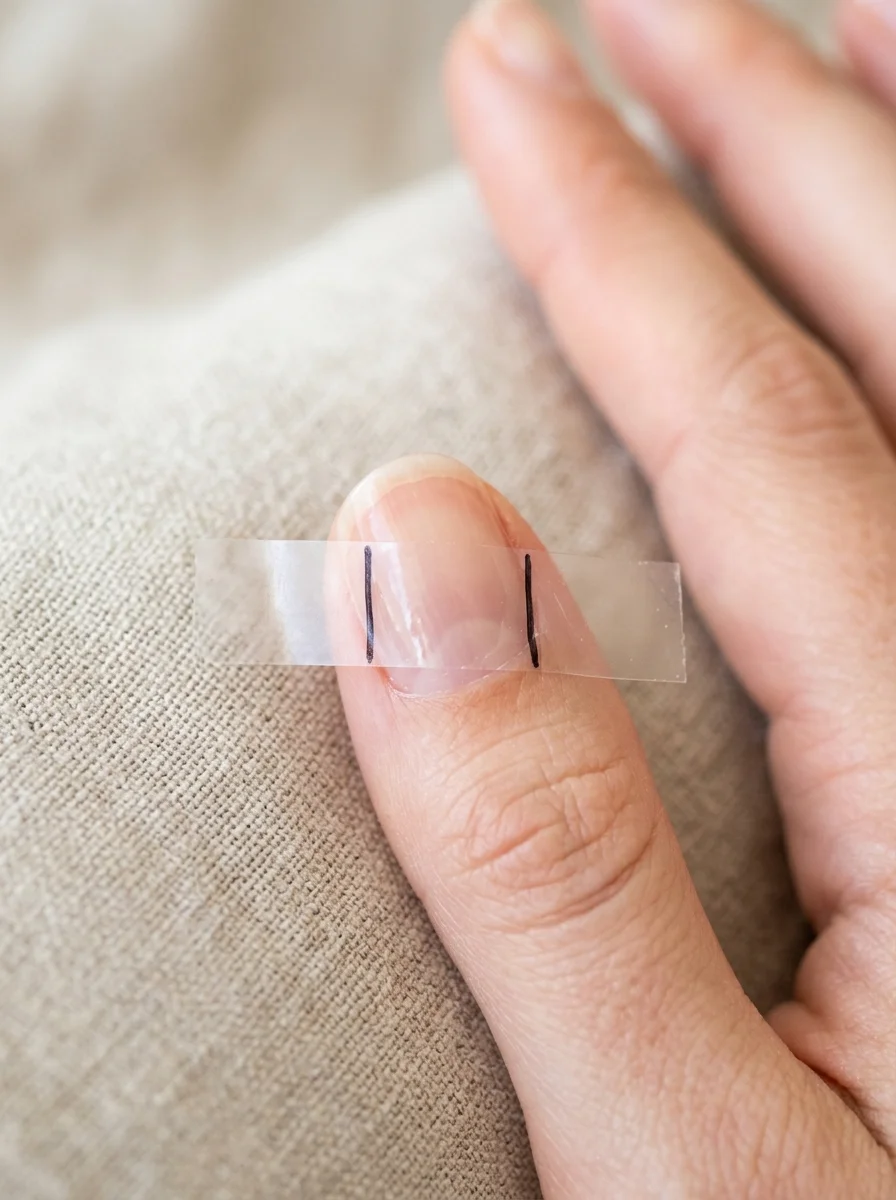
Cut a small strip of clear tape and press it horizontally across the widest section of your unpolished natural nail (typically across the middle third of the nail plate). Smooth the tape firmly down into the sidewall grooves where the nail plate meets the skin, ensuring there are no air bubbles or wrinkles.
Step 2: Mark Both Lateral Sidewall Grooves
Using your fine-tip pen, make a precise vertical mark on the tape at the exact point where the nail plate meets the sidewall on the left, and another mark on the right. Keep your finger relaxed and resting on a flat surface so the skin does not bunch up against the pen tip.
Step 3: Lay Tape Flat and Measure the Distance
Carefully peel the tape off your nail and press it completely flat onto a plain piece of paper. Place your metric ruler directly beneath the marks and count the millimeters between the two lines. Each individual hash mark on a metric ruler represents one millimeter.
Step 4: Measure All 10 Fingers
Natural hand anatomy is rarely perfectly symmetrical. Your dominant hand may have slightly wider nail beds than your non-dominant hand due to daily usage. Take the time to measure all ten fingers individually and record the numbers from thumb to pinky (for example, Right: 15mm, 12mm, 13mm, 11mm, 8mm; Left: 15mm, 11.5mm, 13mm, 11mm, 8mm).
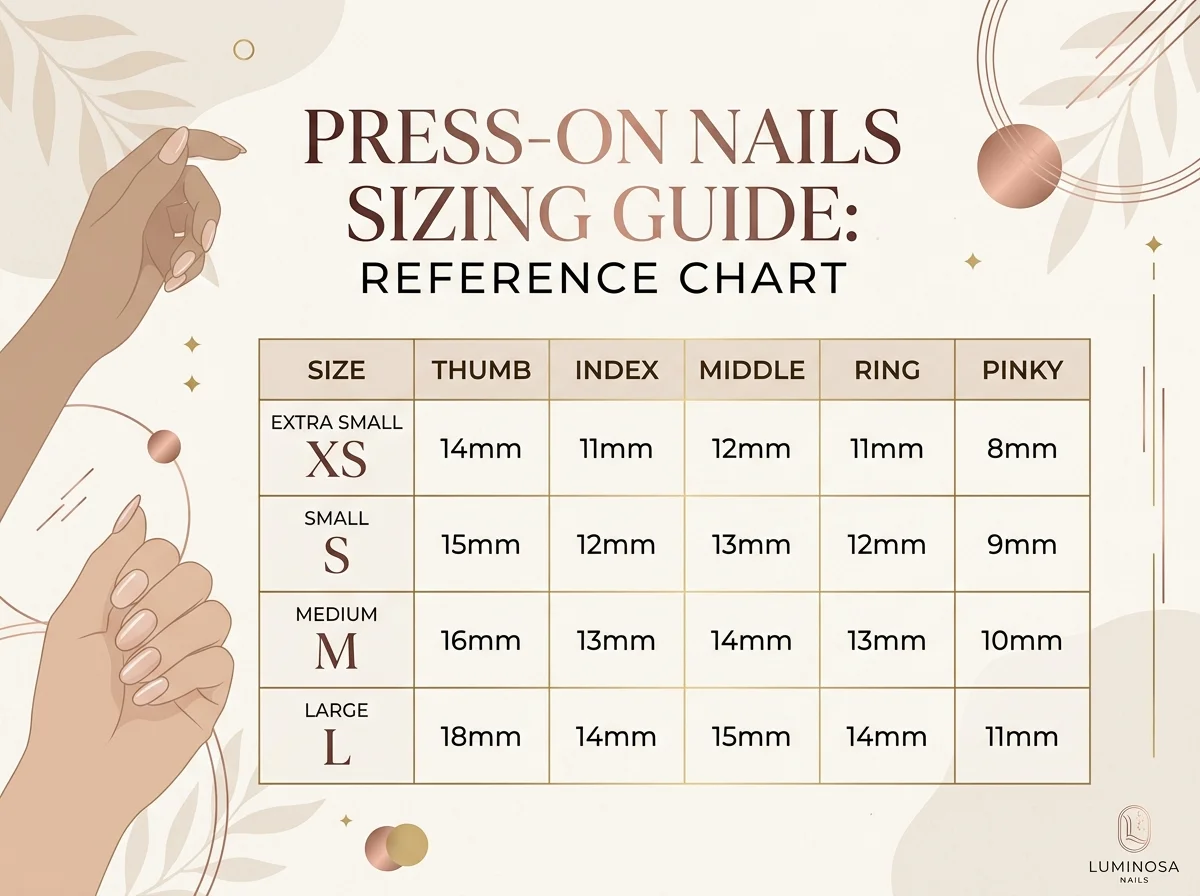
Example Reference Sizing Chart (Measurements in Millimeters)
Important Note on Sizing: Press-on nail sizes are not standardized across all brands and nail artists. The measurements below represent common sizing ranges used by many boutique makers, but you should always compare your recorded millimeter width directly against the specific size chart provided by the seller before ordering.
| Example Size Tier | Thumb | Index | Middle | Ring | Pinky |
|---|---|---|---|---|---|
| Extra Small (XS) | ~14 mm | ~11 mm | ~12 mm | ~10 mm | ~8 mm |
| Small (S) | ~15 mm | ~12 mm | ~13 mm | ~11 mm | ~8 / 9 mm |
| Medium (M) | ~16 mm | ~12 / 13 mm | ~14 mm | ~12 mm | ~9 mm |
| Large (L) | ~17 mm | ~13 / 14 mm | ~15 mm | ~13 mm | ~10 mm |
Custom Millimeter Sizing
Many independent nail artists and boutique studios offer custom sizing. Instead of choosing a pre-set tier like Small or Medium, you can provide your exact five-finger millimeter measurements when ordering. This option is particularly helpful if your thumbs and fingers fall into different standard categories.
Three Critical Factors for a Reliable Fit
Factor 1: What to Do When Between Sizes
If your measurement falls between two sizes (for instance, 12.5 mm when the chart lists 12 mm and 13 mm), compare both measurements with the seller's sizing chart. If the seller recommends sizing up, a slightly larger nail can usually be filed down at the sidewalls; a nail that is too small cannot be widened.
Factor 2: Nail Bed Curvature (Flat vs. Pronounced C-Curve)
If you have flatter nail beds, a press-on with a more pronounced C-curve may leave a gap underneath. Likewise, a flatter press-on may feel tighter across a naturally curved nail. Checking the seller's shape and curvature information can help you choose a better match.
Factor 3: Shape and Length Interaction with Daily Routines
Nail silhouette also changes how a set feels on your hands. A tapered almond nail narrows toward a soft point, while a classic square nail maintains straight sidewalls that emphasize width. To explore how outline choices affect everyday comfort and typing, read our almond vs square nails comparison guide.
Adelline Store Collection Previews & Sizing Information
Adelline Store is currently previewing curated nail designs and visual inspiration. Checkout and orders are not yet active. When product availability and checkout open, detailed millimeter specifications, piece counts, and sizing options will be provided for every design. In the meantime, you can explore our design collection previews or browse styling ideas in our nail inspiration gallery.
Frequently Asked Questions About Measuring Nails
How do I measure my nails without a soft measuring tape?
Clear tape can be a practical alternative because it can be marked directly across the nail and then measured flat against a metric ruler.
What should I do if my measurement falls between two sizes?
If you are between sizes, compare both measurements with the seller's sizing chart. If the seller recommends sizing up, a slightly larger nail can usually be filed down at the sidewalls; a nail that is too small cannot be widened.
Are press-on nail sizes universal across all brands?
No. Number designations (such as 0 through 9) and size categories (XS through L) differ between manufacturers. Always verify your recorded millimeters against the specific chart provided for the set you are considering.
Why do different fingers match different standard size tiers?
Natural hand anatomy varies from person to person. It is very common to have a Medium-width thumb paired with Small-width fingers. For non-standard proportions, custom-sized sets or full sets containing multiple piece sizes offer the most adaptable fit.
Keep exploring
Photo gallery · French tip design guide · Almond vs square guide · Nail finishes guide · Buying checklist · Explore collection